Sincer the War, much of Japan's culture has changed, or has been told to change. One of the affected system is the shape of families. Like many other things, Japan learned this from the U.S: The important thing is not the family line or lineage, but individuals. Married couples don't belong to the families; they should make their new families So, the members of a family should be parents and children; two generations.
The idea is right and it was necessary for Japanese society, especially for women Japanese women began to be treated as individuals.
When I got married, I, of course, wanted to be independent from my husband's family. I didn't like to live with my husband's parents, but when our elder son was 6, we started living next to my husband's parents because we needed babysitting. Thanks to them, we could work fulltime and raise two children. But my idea of family unit was parents and children, and as much as I could I tried not to depend on them. Making meals, cleaning the house, and laudry were the housework we could not rely on, Ithought. And I rejected the conservative way of life of old people.
But recently my opinion is changing .
I live with my husband and my elder son's family; his wife and their two sons. Each of us has our own kitchen, but we have meals and teas .together, and the children always play in our living room. (Many people are surprised to learn that we not only live together, but also have meals together.)
I find many benefits to living in a big family, and above all, it is good for children, I think. They can have many adults who love them, and it's very happy for them. Today our younger grandson chose to stay home with us, grandparents, while his brother went to the dentist with his mother. He practiced riding a bike with his grandfather and helped me picking vegetables in the garden. It was better for him than reading at the waiting room. For children adult people are like the windows to see the world and people. Having many windows is lucky. If the grandparents can show them their traditional culture like farming, fishing, dancing, or music, it is even better.
My husband says I have changed my opinion as my situation has changed. Yes, I have to admit it. I'm not a young wife trying to protest against the old custom now. .
Friday, March 30, 2012

Sunday, March 18, 2012
Sorrow and anger of the victims of nuke in Fukushima

On the 10th of March, I went to Fukushima to join a gathering held by the women who have worked and protested about the nuclear polution. In the meeting, a declaration was read. I tried to translate it to have many people hear their voices. I'm not sure if I could have translated it well, but you can know their sorrow and anger.
The Declaration of the Victims' Right from the Fukushima Nuclear Power Plant Accident
On the 11th of March, 2011, the TEPCO accident at the Fukushima 1st Nuclear Power Plant that followed the earth quake and tsunami suddenly and completely deprived us of our daily lives. Although the damage was huge and serious, we, the victims, have been kept from the information we needed. Without receiving adequate support, we continue to suffer exposure to radiation, and along with the resultant anxiety we are seperated and hurt very deeply.
More than 150,000 people had to seek refuge, and the people living in the poluted area have to deal with the radiation every day.without hope for revivification. We have been deprived of the human right to live happily with dignity.
Embarking on the second year of the aftermath of the TEPCO nuclear disaster, we, the victims of the accident, declare today to protect our lives and dignity.
* We are the victims of the accident at the Fukushima 1st Nuclear Power Plant that was brought about by the negligence of the Tokyo Electoric Power Co.
* Everything that was deprived by this man-made disaster should be fully compensated by those responsible for the radiation.
* We have the right to live happily with dignity.
* We have the right to live in safe places.
* We have the right to have our choices respected, whether to stay in Fukushima or to leave, and in both choices, our lives should be secured.
* We have the right to get all information regarding the accident and the danger.
* We have the right to get the radiation protection measures including evacuation and refuge, and continued health care covering regulr examinations and treatment.
* We have the right to participate in the decisions that concern our future , our families, and our communities.
We will not be deprived any more. We will not lose any more.
We, both those who stay in our homeland, and those who leave, will overcome the difficulty together.We will survive with dignity, create a world with happiness, without discrimination, and do our duty for future generations.
The Declaration of the Victims' Right from the Fukushima Nuclear Power Plant Accident
On the 11th of March, 2011, the TEPCO accident at the Fukushima 1st Nuclear Power Plant that followed the earth quake and tsunami suddenly and completely deprived us of our daily lives. Although the damage was huge and serious, we, the victims, have been kept from the information we needed. Without receiving adequate support, we continue to suffer exposure to radiation, and along with the resultant anxiety we are seperated and hurt very deeply.
More than 150,000 people had to seek refuge, and the people living in the poluted area have to deal with the radiation every day.without hope for revivification. We have been deprived of the human right to live happily with dignity.
Embarking on the second year of the aftermath of the TEPCO nuclear disaster, we, the victims of the accident, declare today to protect our lives and dignity.
* We are the victims of the accident at the Fukushima 1st Nuclear Power Plant that was brought about by the negligence of the Tokyo Electoric Power Co.
* Everything that was deprived by this man-made disaster should be fully compensated by those responsible for the radiation.
* We have the right to live happily with dignity.
* We have the right to live in safe places.
* We have the right to have our choices respected, whether to stay in Fukushima or to leave, and in both choices, our lives should be secured.
* We have the right to get all information regarding the accident and the danger.
* We have the right to get the radiation protection measures including evacuation and refuge, and continued health care covering regulr examinations and treatment.
* We have the right to participate in the decisions that concern our future , our families, and our communities.
We will not be deprived any more. We will not lose any more.
We, both those who stay in our homeland, and those who leave, will overcome the difficulty together.We will survive with dignity, create a world with happiness, without discrimination, and do our duty for future generations.
Monday, November 28, 2011
Voice Of FUKUSHIMA
There was a b ig anti-NUKE gathering in September in
 Tokyo. A speech given by a woman from Fukushima moved people deeply. I tried to translate it for foreigers. I'm not sure if I could translate it successfuly, but could you guess what she said in her speech and forgive my mistakes?

Ruiko Muto's speech at the gathering on Sep.19th in Tokyo
Everyone, Fukushima is a very beautiful place. In the east we view the blue Pacific Ocean, and in the central area, we have rich orchards of peaches, pears, and apples. Around the Inawashiro Lake and Mt.Bandai,we have Aizu Plain with golden rice fields. Beyond them, we see deep rows of mountains. The mountains are green and the waters are clear, our homeland. But after the accident at the nuclear plant on March 11th, invisible radiation fell on us, and we are now nuclear victims.
 ig anti-NUKE gathering in September in
 Tokyo. A speech given by a woman from Fukushima moved people deeply. I tried to translate it for foreigers. I'm not sure if I could translate it successfuly, but could you guess what she said in her speech and forgive my mistakes?
Ruiko Muto's speech at the gathering on Sep.19th in Tokyo
People from Fukushima, would you all stand up, please.
Hello, everyone,we came from Fukushima. Today, we came together in a line of buses , from Fukushima Prefecture, from refugee camps.Among us, there are many who are joining these gatherings or demonstrations for the first time. We talked and decided to come, to tell the sorrow caused by the explosion at the Fukushima nuclear plant. We are the ones to demand "No Nukes"
First of all, I 'd like to say, I deeply respect each of you all who have worked to save lives during these hard days since March 11th. And, I am so grateful to the people who gave us their helping hands, cooperated with us, and supported us in many ways. Thank you very much. And, as the generation that have had this happen to them, I have to apologize sincerely to the children and the young people whom we made carry this heavy burden.
Everyone, Fukushima is a very beautiful place. In the east we view the blue Pacific Ocean, and in the central area, we have rich orchards of peaches, pears, and apples. Around the Inawashiro Lake and Mt.Bandai,we have Aizu Plain with golden rice fields. Beyond them, we see deep rows of mountains. The mountains are green and the waters are clear, our homeland. But after the accident at the nuclear plant on March 11th, invisible radiation fell on us, and we are now nuclear victims.
In the state of confusion, many things happened among us. People were split between uneasiness and the quick advertisement which declear "It's safe." So many people felt anxious and sad in the community, in the work place, at school, and at home. Day after day, we had to choose and decide; refuge or not, eat or not, make the children wear masks or not, dry the laundry outside or not, plow the farm or not, and say something or keep our mouths shut. We had to make many difficult decisions.
Now a half a year has passed, and things are becoming clear: like "The truth is hidden." "The nation never protects its people." "The accident is not over yet." "The people of Fukushima will be the nuclear test subjects." "A huge amount of nuclear waste remains." "There are people that insist on pushing the nuclear power plants even though we have these victims already." " We were thrown away." We sigh deeply tired and desperate.
But we dare say, "Don't fool us." and " Don't kill us." We, the people of Fukushima, now begin to stand up quietly in the anger and sorrow. Fathers, mothers, grandfathers, and grandmothers to save the childen, young people not to be deprived their future, working people to save the nucler plant workers who are treating the troubled plant suffering from the terrible amount of radiation, farmers in the desperation whose farms were polluted, disabled people to stop the new kind of discrimination and separation, each of these citizens are inquiring after the responsibility of the government and Tokyo Denryoku. And we are saying, " We don't need nuclear power stations any more."
We are the demons of Tohoku(North-eastern Japan) who keep the flame of anger under our skin quietly. We, the people of Fukushima, both those who leave the hometown and those who stay and llve there, want to share our anguish, responsibility, and hope, and live togethr helping each other.
Connect with us. Pay attention to our action; negotiation with the government, evacuation, lawsuit, refuge, employment, cleaning of the radiation, measurement of the radiation, learning about the nuclear power station and radiation, and so on. We will go anywhere and will talk about Fukushima. One of us is now making a speech far in New York today. We are doing everything we can do now. Help us. Never forget Fukushima, please.
I would like to tell you one more thing. It's about our way of life, our style of living. We have to imagine what is beyond the outlet we plug casually. We should thimk over the fact that convenience and development is dependent on discrimination and sacrifice. Nuclear power stations are over there.
Human being is just one of the creatures living on the Earth. No other creatures destroy their own future. I want to live a right life that is harmonious with this beautiful planet as the creature on it. I want to live a life which is not luxurious, but energy-saving, resourceful, and creative.
No one exactly knows how to make the new world that is opposite from the nuclear power stations The only thing we can do is not to obey some other's decisions, but think deeply with seriousness ourselves, open our eyes wide, decide what we can do, and act. Remember that everyone of us has the power to do so. We have courage to change. Take our self-confidence back, which has been deprived of.
When we liken the power to promote nukes to a wall standing vertically, our strength is to join and widen levely. Take a hand of your neighbor standing next to you now. Let' s listen to the pain of the others. Let the tears and anger allow. Let's extend the warmth of our joined hands all over Japan, and all over the world. Even if our burden is incredibly heavy, and our journey is so harsh, we shall survive lightly and pleasanly supporting each other.
Thank you. .
Monday, February 14, 2011
WHY A NEW BASE IN OKINAWA?
I was thinking of closing my blog, but my husband tells me I should write about Okinawa for the foreign people in Japan, especially American. I know my blog has only a few readers, and so I wonder if it's useful. But anyway I'll try.
We visited Okinawa with some other members of '9 jou no kai' (Movement to protect Article 9)on January 31. We have been very concerned about Okinawa especially since last year. We can't let the matter with Okinawa pass without a protest. Peace of Japan and our future are deeply related to Okinawa. So we wanted to watch Okinawa with our own eyes and to know what we can do. We have a good guide who lives in Okinawa and keeps acting about the matter of the U.S. army bases and protecting nature. His name is Mr. Kim and he was once in Saku.
First, we went to the southern part of the island. It was the battlefield sixty-five years ago. Many people tried to flee from the attack of the U.S. army and strayed and died there. About 230000 people including American soldiers and Korean people were killed in the battle. We visited the stone monuments on which all the names of them were curved. They were rows and rows of the stones with names....
On the second day, we went to the places from where we could see the U.S. bases well. The bases are huge and surrounded with fences with signs that is saying,"No entry without permission. If you do, you will be punished by the Japanese law." What!!? About 20 percent of the land of Okinawa is occupied as the U.S.bases. Do you know it's not only land, but also sky and sea! Why does a nation have a right to occupy another independent nation and expel citizens? I can't understand.
The third day was the most important day. We went to the northern area of the island, where is the rich forest with many rare species. The U.S. army is using the area as training places with many facilities such as helicopters pads. They want more heli pad near a small village called Takae, and so the government of Japan is making it. The villagers who want safe and quiet life and want to save the forest have been against the plan for some years. But the village is small and far from the big cities, and little media have informed the matter. Since this January the Defense Bureau has sent many people to force the constructions work. On the other hand, the government brought the villagers to a trial for 'disturbing traffic'!!! When we visit there, the people who were protesting looked cheerful, but sitting down and protesting more than two years can't be easy or fun. When I check their blog these days, it often says, "They are coming. Come and help us." "A big construction machine is moving inside the fence."
The situation is the same at Henoko, Nago City, whose beautiful sea is going to be a new army base of the U.S. The people of the city said "No" through the votes twice (election for the mayor and the members of the city assembly). They had to accept the bases in exchange for money from the government. But now they realized that they can't be happy or safe with army bases. The U.S. has demanded the new and empowered base, and the governments of Japan, that can't say "No" to America, is kicking its own people out and obey its boss. We, Japanese people are already paying 500,000,000en a day for the U.S. bases, and of course, we are going to pay all the money to make the new base. Why do we have to pay from our tax money? If you like wars, please make army bases in your own country, and train your soldiers with your money.
We also met some people and talked with them. A eighty-two-year-old woman who was burned with a flamethrower during the war said, "And so, I hate everything related wars. I can't accept the army bases, where people learn how to kill."
Yes, we have learned that armed forces can't make peace. Look at Iraq. Look at Israel. Whose benefit was it? Someone must get money. Someone must get power. We are just citizens. Wars bring us no benefit, let’s stop supporting wars. And so, we don't need any army bases. It's time to find another way to make peace, I think.
Forgive me I'm too excited. I'm dreaming the day when all the people can live in peace and all the children feel no fear. I hope we can share the dream. Thank you for reading my long essay.
We visited Okinawa with some other members of '9 jou no kai' (Movement to protect Article 9)on January 31. We have been very concerned about Okinawa especially since last year. We can't let the matter with Okinawa pass without a protest. Peace of Japan and our
 future are deeply related to Okinawa. So we wanted to watch Okinawa with our own eyes and to know what we can do. We have a good guide who lives in Okinawa and keeps acting about the matter of the U.S. army bases and protecting nature. His name is Mr. Kim and he was once in Saku.
First, we went to the southern part of the island. It was the battlefield sixty-five years ago. Many people tried to flee from the attack of the U.S. army and strayed and died there. About 230000 people including American soldiers and Korean people were killed in the battle. We visited the stone monuments on which all the names of them were curved. They were rows and rows of the stones with names....
On the second day, we went to the places from where we could see the U.S. bases well. The bases are huge and surrounded with fences with signs that is saying,"No entry without permission. If you do, you will be punished by the Japanese law." What!!? About 20 percent of the land of Okinawa is occupied as the U.S.bases. Do you know it's not only land, but also sky and sea! Why does a nation have a right to occupy another independent nation and expel citizens? I can't understand.
The third day was the most important day. We went to the northern area of the island, where is the rich forest with many rare species. The U.S. army is using the area as training places with many facilities such as helicopters pads. They want more heli pad near a small village called Takae, and so the government of Japan is making it. The villagers who want safe and quiet life and want to save the forest have been against the plan for some years. But the village is small and far from the big cities, and little media have informed the matter. Since this January the Defense Bureau has sent many people to force the constructions work. On the other hand, the government brought the villagers to a trial for 'disturbing traffic'!!! When we visit there, the people who were protesting looked cheerful, but sitting down and protesting more than two years can't be easy or fun. When I check their blog these days, it often says, "They are coming. Come and help us." "A big construction machine is moving inside the fence."
The situation is the same at Henoko, Nago City, whose beautiful sea is going to be a new army base of the U.S. The people of the city said "No" through the votes twice (election for the mayor and the members of the city assembly). They had to accept the bases in exchange for money from the government. But
 now they realized that they can't be happy or safe with army bases. The U.S. has demanded the new and empowered base, and the governments of Japan, that can't say "No" to America, is kicking its own people out and obey its boss. We, Japanese people are already paying 500,000,000en a day for the U.S. bases, and of course, we are going to pay all the money to make the new base. Why do we have to pay from our tax money? If you like wars, please make army bases in your own country, and train your soldiers with your money.
We also met some people and talked with them. A eighty-two-year-old woman who was burned with a flamethrower during the war said, "And so, I hate everything related wars. I can't accept the army bases, where people learn how to kill."
Yes, we have learned that armed forces can't make peace. Look at Iraq. Look at Israel. Whose benefit was it? Someone must get money. Someone must get power. We are just citizens. Wars bring us no benefit, let’s stop supporting wars. And so, we don't need any army bases. It's time to find another way to make peace, I think.
Forgive me I'm too excited. I'm dreaming the day when all the people can live in peace and all the children feel no fear. I hope we can share the dream. Thank you for reading my long essay.
Wednesday, July 7, 2010
WHAT A SHAME !
 Did you see the photo of the primeminister of Japan and the U.S.president shaking hands
 on papers? Primeminister Kan promised Obama to build the new U.S. army base in Okinawa without delay. What a shame!!!
One of the grass-roots movement organization put an opinion
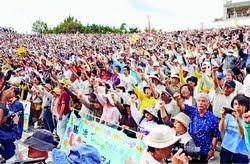 ad on the Washington Post in April. They raised a fund for it, and I was one of the contributor. The ad said, "Would you want 30 military bases in your backyard? / Last Sunday, tens of thousands of Okinawans gathered to protest plans to build a new U.S. military base on their island. This island in Japan already devotes 20% of its land to U.S. bases. The governor, the mayors, and the voters of Okinawa all oppose another base. / The new base would damage the health and safty of people and threaten a unique ecosystem that contains many rare species. This includes the Okinawan dugong, an endangered cousin of the manatee. / Washington is pressuring Tokyo to ignore the voices of its citizens, despite a U.S. federal court decision that the new facility would violate U.S. law. All for a military base of no strategic value. / Stand up for democracy. Tell the Obama Administration: We don't need this base in Okinawa. "
How many Amerians read this ad and thought of the suffering of Okinawa? Most of them have never heard of it, and never thought of it. I suppose it has not been even a news on the papers or TV in America. But I want the people of the U.S. realize that your country sometimes treat its dependencies very badly. It's far from democracy and justice.
Once Okinawa was an independent kingdom called Ryukyu, but one of Japanese lords in Edo era attacked and occupied it. Meiji government made it one of the prefectures of Japan. During the World War II, the headquarter of Japan wanted Okinawa to fight against and detain the U.S. army to protect Tokyo and the Emperor. More than 100,000 Okinawan citizens were killed. When the war ended, the U.S. army occupied Okinawa and it wasn't given back to Japan untill 1972. The land was taken by guns and tanks of U.S. army and made its military bases. The islands came back to Japan with 30 U.S.military bases in that small island. It's been 65 years since the war, and the condition of the world has changed a lot, but even now the U.S.is using the land as their military bases. They say it's the most dangerous base in the world, and the people living next to the bases are suffering noises, danger, and the soldiers' crimes. Even now the U.S. has a kind of extraterritoriality in Okinawa.
But we can't blame the U.S. only. WE are the ones to be blamed. We used Okinawa as a shield in the war. We sold it to America And we are choosing the governent that can't say "No" to America, that ignores the voices of Okinawa. The primeminiser changed, then the problem of Okinawa seems to be vanished. I feel so guilty. I want to apologize to Okinawans. What can we do about this problem? I think this is not only the problem for Okinawans, but also all of us. It's a problem of democracy, a problem of peace and war, and a problem of natural environment. I would like to hear your opinions.
Wednesday, February 3, 2010
Difficult Problem for Me
I love to visit other countries and see the people living there. My husband and I sometimes go on cheap tours abroad. If I were younger and had more money, I could have traveled more adventurously. When I was young, I had neither time nor money. And even now, I don't have much money and I can't leave home for very long. But I enjoy walking around the foreign towns and talking with people there.
The best place we visited was Uzbekistan. Its culture on the Silk Road was interesting, and the people were so friendly. The country seemed not so rich, and the life of the people in their folk clothes wasn't modernized very much, but they looked happy. We saw no streetchildren, no beggers on the streets. Even though how beautifulI the the scenery is, or, how interesting the history is, I can't enjoy the trip when I see those people.
There ia a problem with trips abroad. When I go to other countries, I always feel embarrassed with the custom of 'tipng'.
Some twenty years ago we went to America for the first ttime. At a restaurant in the hotel in L.A. a waitress was kind enough to give us some information about Disney Land. Thanks to her, we could enjoy the park with our son, and the next day we wanted to say "thank you" to her. But she never came up to us, never smiled to us. We didn't understand what was wrong, but later, I understood. The reason she was in such a bad mood was that we didn't give her any tip! Her kindness and her sweet smile was for a large tip!
For us, Japanese, kindness requires no repay. We try to be kind not expecting any repay. If I would change my attitude about my job because of small money, I would not be respected.
In foreign countries I always have to worry about waitresses' smile or porters' greeting whether it is for money, or from their heart, and it makes me unconfortable. At the same time I often see that cashiers and clerks are so sullen. I wonder if I have to ask them, "Would you please sell this to me kindly?"? They don't have to wear any smile to the customers because they don't expect any special money from the customers for their smile. I feel a little sad. Smile and kindness makes everyone happy without money .
Some says that their wages are low and it is figured to include their tips. It's strange and not fair. The company or the owner should pay them enough for their work since the owners get enough money from their customers.
OK, I try to respect your 'tipping' custom and give some tip to the people who do small ruoutine work for me. But how do you hand your tip in a refined manner? Old Japanese people feel it's rude to give bare bills or coins to someone. Do you always put coins and small bills in your pockets? Women don't do it, so, where do you have small money for tip? It takes too long to open my handbag, then open my wallet, grab some coins from it, and count them. Are you always calculating the amount of tip when you are eating at a restaurant or talking with porters, like, "Ten percent? No, her smile is nice, fifteen percent. Oh, she is winking to me, it should be twenty." Isn't it a tiring job?
You might ask me, " If Japanese are kind without expecting repay, then please explain the news about the politicians and money." I'm sorry, but I have never seen such big money. Show me that big money, then I might change my idea.
The best place we visited was Uzbekistan. Its culture on the Silk Road was interesting, and the people were so friendly. The country seemed not so rich, and the life of the people in their folk clothes wasn't modernized very much, but they looked happy. We saw no streetchildren, no beggers on the streets. Even though how beautifulI the the scenery is, or, how interesting the history is, I can't enjoy the trip when I see those people.
There ia a problem with trips abroad. When I go to other countries, I always feel embarrassed with the custom of 'tipng'.
Some twenty years ago we went to America for the first ttime. At a restaurant in the hotel in L.A. a waitress was kind enough to give us some information about Disney Land. Thanks to her, we could enjoy the park with our son, and the next day we wanted to say "thank you" to her. But she never came up to us, never smiled to us. We didn't understand what was wrong, but later, I understood. The reason she was in such a bad mood was that we didn't give her any tip! Her kindness and her sweet smile was for a large tip!
For us, Japanese, kindness requires no repay. We try to be kind not expecting any repay. If I would change my attitude about my job because of small money, I would not be respected.
In foreign countries I always have to worry about waitresses' smile or porters' greeting whether it is for money, or from their heart, and it makes me unconfortable. At the same time I often see that cashiers and clerks are so sullen. I wonder if I have to ask them, "Would you please sell this to me kindly?"? They don't have to wear any smile to the customers because they don't expect any special money from the customers for their smile. I feel a little sad. Smile and kindness makes everyone happy without money .
Some says that their wages are low and it is figured to include their tips. It's strange and not fair. The company or the owner should pay them enough for their work since the owners get enough money from their customers.
OK, I try to respect your 'tipping' custom and give some tip to the people who do small ruoutine work for me. But how do you hand your tip in a refined manner? Old Japanese people feel it's rude to give bare bills or coins to someone. Do you always put coins and small bills in your pockets? Women don't do it, so, where do you have small money for tip? It takes too long to open my handbag, then open my wallet, grab some coins from it, and count them. Are you always calculating the amount of tip when you are eating at a restaurant or talking with porters, like, "Ten percent? No, her smile is nice, fifteen percent. Oh, she is winking to me, it should be twenty." Isn't it a tiring job?
You might ask me, " If Japanese are kind without expecting repay, then please explain the news about the politicians and money." I'm sorry, but I have never seen such big money. Show me that big money, then I might change my idea.
Wednesday, December 30, 2009
I wish you a Happy New Year
A few days ago I knew this blog had a new reader. I haven't expected it. I have been thiking of closing this blog, but I'll write a little more.
Christmas is gone, and the new year will soon come. How were your days in Japan this year? Did you enjoy the days here? I hope you did. Living in other countries and other cultures will give you a great chance of learning. I wish I could have such a chance when I was young.
Yesterday I watched a film of a fifteen-year-old girl who went to stay in Mongoria alone. She could not go to school those days, and she wanted to change herself. Yes, through the experience in another cculture, she changed a lot. The person who was taking care of her through the horse riding lesson, and arranged the trip to Mongoria is one of our friends. He loves the people of Mongoria and their way of life a lot. What are you learning here in Japan?
In 2009, the president of the U.S. and the primeminister of Japan both changed. We, Japanese people found a great hope in Obama's adress referring to the ressetion of the nuclear weapons. The Nobel Peace Prize to him ment an expectation or encouragement, we thought. But in his speech as a winner of the prize, he justified the U.S. wars. Justice for what? And the issue of the U.S.army base in Okinawa. The U.S. army has more than 140 bases in this small Japan, and we pay more than 200000000000 yen to support them every year. Why does the U.S. government ge t angry when we want to remove only one of those 140 bases? Our new government of Japan is not brave and they can't be against their boss, I'm afraid.
I get too mad when I think of this issue. Calm down, it's the end of the year. What's your plan for the New Year's holidays? We will be with our sons' families. I'm happy to see our younger son and his wife after five months and to enjoy the New Year with our sons' families.I wish you all and all the world a happy new year!
Christmas is gone, and the new year will soon come. How were your days in Japan this year? Did you enjoy the days here? I hope you did. Living in other countries and other cultures will give you a great chance of learning. I wish I could have such a chance when I was young.
Yesterday I watched a film of a fifteen-year-old girl who went to stay in Mongoria
 alone. She could not go to school those days, and she wanted to change herself. Yes, through the experience in another cculture, she changed a lot. The person who was taking care of her through the horse riding lesson, and arranged the trip to Mongoria is one of our friends. He loves the people of Mongoria and their way of life a lot. What are you learning here in Japan?
In 2009, the president of the U.S. and the primeminister of Japan both changed. We, Japanese people found a great hope in Obama's adress referring to the ressetion of the nuclear weapons. The Nobel Peace Prize to him ment an expectation or encouragement, we thought. But in his speech as a winner of the prize, he justified the U.S. wars. Justice for what? And the issue of the U.S.army base in Okinawa. The U.S. army has more than 140 bases in this small Japan, and we pay more than 200000000000 yen to support them every year. Why does the U.S. government ge
 t angry when we want to remove only one of those 140 bases? Our new government of Japan is not brave and they can't be against their boss, I'm afraid.
I get too mad when I think of this issue. Calm down, it's the end of the year. What's your plan for the New Year's holidays? We will be with our sons' families. I'm happy to see our younger son and his wife after five months and to enjoy the New Year with our sons' families.I wish you all and all the world a happy new year!
Subscribe to:
Posts (Atom)